A leading telecommunications provider serving millions of subscribers across multiple regions, delivering mobile services, broadband solutions, and enterprise-grade connectivity. The organization supports a vast and diverse customer base with always-on digital services. Its operations generate high-velocity, high-volume data from complex network elements. Additional data flows originate from OSS/BSS platforms that manage operations, billing, and service assurance. Customer-facing applications further contribute to real-time usage and experience data across channels.
Data was scattered across multiple OSS/BSS platforms, network systems, and monitoring tools, creating silos across teams. This fragmentation limited end-to-end visibility into network performance and customer experience. As a result, correlating insights across layers required manual effort and delayed root-cause analysis.
Batch-based data processing and legacy reporting systems introduced significant delays in analytics. Business and network teams lacked access to near real-time insights needed for proactive decision-making. This slowed response times for service issues, performance optimization, and customer experience improvements.
The client had minimal AI-driven capabilities to predict customer churn or forecast network capacity demands. Existing models were either rule-based or reactive, offering limited accuracy. This restricted the ability to take preventive actions and optimize resources ahead of demand spikes.
Multiple overlapping data pipelines increased infrastructure costs and operational complexity. Inconsistent governance and data quality controls further added compliance and security risks. Managing these redundant pipelines strained budgets while reducing overall efficiency and scalability.
A Data and AI-first approach powered by the Databricks Lakehouse platform.
Unified Data Platform for Real-Time Insights
A centralized, unified data platform was implemented by Daten team to bring together data from OSS/BSS systems, network layers, and customer applications. This enabled seamless data integration and eliminated silos across teams. Real-time and near real-time analytics empowered faster, data-driven decisions across operations and business functions.
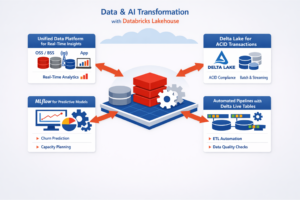
Our team adopted Delta Lake to ensure reliable, ACID-compliant transactions across large-scale data workloads. It improved data consistency, quality, and versioning while supporting both batch and streaming use cases. This provided a trusted single source of truth for analytics and downstream applications.
MLflow was used to manage the full lifecycle of machine learning models, from experimentation to deployment. It enabled standardized tracking, versioning, and governance of predictive models. This supported advanced use cases such as churn prediction and proactive capacity planning with higher accuracy.
Delta Live Tables were leveraged to automate end-to-end data pipelines with built-in data quality checks. This reduced manual intervention and simplified pipeline maintenance. Automated orchestration improved reliability, scalability, and faster delivery of analytics-ready data.
Unified OSS/BSS, network, and customer data into a single Lakehouse, enabled near real-time analytics. This helped business and operations teams move from delayed reporting to proactive decision-making for network performance, customer experience, and service optimization.
Implemented scalable ML models for churn prediction and capacity forecasting, allowing the client to identify at-risk customers early and optimize network investments. This resulted in more targeted retention strategies and better utilization of infrastructure.
Eliminated redundant pipelines and data duplication by standardizing ingestion and governance on Databricks. Automated pipelines and centralized governance reduced operational costs while ensuring enterprise-grade security and compliance across teams.
By consolidating analytics, AI, and data engineering workloads onto a single Databricks Lakehouse platform, the client maximized ROI from existing data assets. Faster time-to-insight reduced tooling sprawl, and higher reuse of data and ML models led to measurable gains in productivity and overall return on technology investments.
By partnering with Daten, the telecom provider transformed its fragmented data ecosystem into a unified, AI-ready Databricks Lakehouse. Real-time visibility across network, OSS/BSS, and customer data enabled faster, more proactive decision-making at scale. Advanced AI models improved churn prediction and capacity planning, helping the organization optimize customer retention and network investments. Automated, governed data pipelines reduced operational complexity while lowering data engineering costs. Platform consolidation further improved ROI by accelerating time-to-insight and maximizing reuse of data and ML assets. Together, Daten and Databricks empowered the enterprise to operate as a truly data-driven, future-ready telecom organization.


